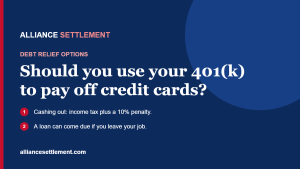
Quick answer: Usually not. Cashing out a 401(k) before age 59½ generally means income tax plus a 10% early-withdrawal penalty, so you can lose about a third of the money before it reaches your cards. A 401(k) loan avoids the tax and penalty if you repay it on time, but the money stops growing and the balance can come due if you leave your job. Your 401(k) is also generally protected from creditors, so it’s worth comparing other options first.
When credit card balances keep growing, the money sitting in a 401(k) can look like an easy way out. It may be the largest pool of cash you have, and paying off 25% APR debt sounds like a good return. The catch is in the taxes, penalties and lost growth, and in the fact that retirement money is one of the few assets credit card companies generally can’t touch.
Option 1: Withdrawing (cashing out) your 401(k)
A withdrawal is permanent. The amount you take out is added to your taxable income for the year, and if you’re under 59½, the IRS generally adds a 10% early-withdrawal penalty on top. Plans usually withhold 20% for federal taxes up front, and state income tax may apply as well.
Here’s a simple example. Say you’re 45, in the 22% federal bracket, and you withdraw $20,000:
- Federal income tax at 22%: about $4,400
- 10% early-withdrawal penalty: $2,000
- State income tax, depending on where you live: several hundred to over $1,000
You could end up with roughly $12,600 to $13,300 to put toward your cards, and the $20,000 you took out no longer grows for retirement. Many plans also don’t allow withdrawals while you still work there, and credit card debt generally isn’t one of the approved reasons for a hardship withdrawal.
One small exception: under the SECURE 2.0 Act, many plans now allow one emergency withdrawal of up to $1,000 per year without the 10% penalty. It’s still taxed, and it’s too small to solve most credit card problems.
Option 2: Taking a 401(k) loan
If your plan offers loans, you can generally borrow the lesser of $50,000 or 50% of your vested balance. You repay it, with interest, through payroll deductions, usually over up to five years. There’s no tax or penalty as long as you stay on schedule, and the interest goes back into your own account.
The risks are real, though:
- Lost growth. The borrowed money is out of the market until you pay it back.
- Job loss. If you leave or lose your job, the remaining balance is generally due by your tax-filing deadline for that year. Whatever isn’t repaid is treated as a withdrawal, with taxes and possibly the 10% penalty.
- Smaller paychecks. Loan payments come out of every check, which can make it harder to keep up with other bills.
- The cards fill back up. If spending doesn’t change, it’s easy to end up with new card balances and a 401(k) loan at the same time.
Why your 401(k) is worth protecting
Money in an employer 401(k) plan is generally protected from creditors, including in bankruptcy. A credit card company that sues you and wins a judgment usually can’t reach it. Once you withdraw the money and put it in a checking account, that protection is gone. In other words, using retirement savings can turn protected money into money that’s exposed, and it may be gone before you know whether other options would have worked.
When using your 401(k) might make sense
It’s rarely the first choice, but a 401(k) loan can be reasonable if your job is stable, the balance is small enough to repay quickly, you’ve stopped adding new card debt and the loan would clear high-interest balances entirely. A withdrawal is harder to justify, because the taxes and penalty are an immediate, guaranteed loss.
Options to compare first
- Call your card issuers. Many have hardship programs that lower the interest rate or payment for a period of time.
- Credit counseling. A nonprofit debt management plan can cut interest rates and roll your cards into one monthly payment. See debt settlement vs. credit counseling.
- Debt settlement. For larger unsecured balances you can’t keep up with, settling for less than the full balance may be an option. Learn which debts can be settled and how much credit card companies settle for.
- Know what happens if you fall behind. Read what happens if you stop paying credit cards before you make a decision under pressure.
If your credit card and other unsecured debt has grown past what you can realistically pay, you may not need to touch your retirement savings at all. Alliance Settlement works with consumers carrying credit card, personal loan and medical debt, with no upfront fees. Programs typically run 12 to 48 months, and our team has been settling consumer debt since 2009. New Jersey clients are served through our partner law firm. Call (866) 376-2333 for a free consultation, or see debt relief options in your state.
Frequently asked questions
Can I withdraw from my 401(k) to pay credit card debt?
Usually only if you have left the employer or reached age 59½, or if your plan allows an in-service or emergency withdrawal. Credit card debt generally doesn’t qualify as a hardship withdrawal reason. Withdrawals are taxed as income, and before 59½ most also carry a 10% early-withdrawal penalty.
Is a 401(k) loan better than a withdrawal?
A loan avoids taxes and the penalty as long as you repay it on schedule, and the interest goes back into your own account. But the money stops growing while it’s out, and if you leave your job the remaining balance generally has to be repaid by your tax-filing deadline or it’s treated as a taxable distribution.
How much can I borrow from my 401(k)?
If your plan offers loans, the limit is generally the lesser of $50,000 or 50% of your vested balance, and most loans must be repaid within five years through payroll deductions.
Can credit card companies take my 401(k)?
Money in an employer 401(k) plan is generally protected from creditors, including in bankruptcy. Once you withdraw it and put it in a bank account, that protection is gone.
What can I do instead of using my 401(k)?
Options include a nonprofit credit counseling plan, negotiating hardship programs with your card issuers, a lower-rate loan if your credit allows, or debt settlement for larger unsecured balances. Each has trade-offs, so compare them before touching retirement savings.
This article is for general information and isn’t tax, legal or investment advice. Retirement plan rules vary by plan; talk to your plan administrator and a tax professional before taking a loan or withdrawal.