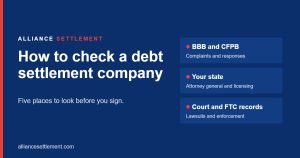
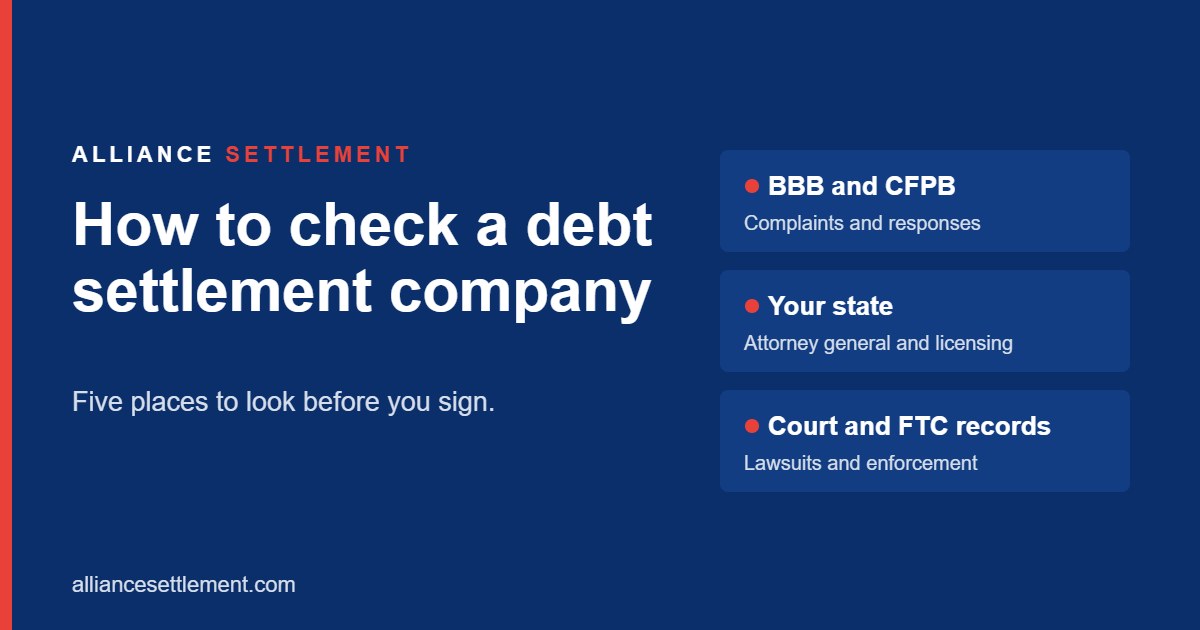
Quick answer: Before you sign with a debt settlement company, look it up in five places: its Better Business Bureau profile, the CFPB Consumer Complaint Database, your state attorney general’s office, your state’s licensing agency if it licenses debt settlement companies, and court and FTC records for lawsuits or enforcement actions. A few complaints are normal for any company; what matters is the pattern, how the company responded and whether regulators have acted.
Every debt settlement company says it is trustworthy. Public records are the way to check. It takes about 30 minutes, and it is worth doing before you hand over account numbers or sign an agreement. Search under the company’s exact legal name, any “doing business as” names and the address on its contract.
1. The Better Business Bureau
Search the company on bbb.org. Look past the letter rating:
- Complaint types. Are people complaining about fees, about money not being returned after they cancelled, or about being sued during the program?
- Responses. Did the company answer each complaint, and were complaints marked resolved?
- Accreditation. Accredited businesses agree to BBB’s standards and its complaint process. Accreditation alone doesn’t prove a company is right for you.
- Customer reviews and the business profile. Check that the name, address and years in business match what the company told you.
2. The CFPB Consumer Complaint Database
The Consumer Financial Protection Bureau publishes complaints it sends to companies, along with the company’s response. Search the company name at consumerfinance.gov. Debt settlement complaints are usually filed under “Debt or credit management.” Read a sample of the complaints in full, not just the count, and look at whether the company responded on time.
3. Your state attorney general
Most state attorneys general handle consumer complaints and announce settlements with companies that broke the law. Search the AG’s website for the company name, or call the consumer protection line and ask whether there are complaints or actions on file.
4. Your state licensing or banking agency
Some states require debt settlement companies to be licensed or registered, and some limit what they can charge. Check your state’s banking or financial regulation department for a license lookup. If your state requires a license and the company does not have one, stop there.
5. Court records and federal actions
- Lawsuits. Search your county court’s online records and the federal PACER system for cases naming the company.
- FTC and CFPB enforcement. Search the company name on ftc.gov and in the CFPB’s enforcement actions. Debt relief companies that charged illegal upfront fees have been shut down this way.
- The people behind it. Search the owners’ names too. Some companies reopen under new names after enforcement actions.
How to read what you find
- Complaints are normal; patterns are not. A larger company will have more complaints. Look for the same problem repeated, such as refunds not paid or fees taken before any settlement.
- The response matters. A company that answers complaints and fixes problems is a better sign than one with no complaints and no history.
- Regulator action is the strongest warning. A state or federal lawsuit or order carries more weight than any number of reviews.
- Too new to check? A company with no record at all, or one that changed names recently, deserves more questions.
Questions to ask after you check
- “I saw complaints about refunds after cancelling. How do you handle that now?”
- “What is your exact legal name, and have you operated under any other name?”
- “Are you licensed in my state, and what is the license number?”
Then use our 10 questions to ask before you choose a debt settlement company, check how the fees should work and read common debt settlement scams.
Alliance Settlement is BBB accredited. We encourage you to look us up the same way.
How Alliance Settlement can help
Alliance Settlement helps people with unsecured debt, including credit cards, personal loans and medical bills. We review everything you owe, explain your options in plain language and negotiate with each creditor on your behalf. There are no upfront fees, and programs typically run 12 to 48 months. Results vary by case. Call (866) 376-2333 for a free consultation.
Frequently asked questions
How do I check if a debt settlement company is legitimate?
Look it up on the Better Business Bureau, the CFPB Consumer Complaint Database, your state attorney general’s website and your state’s licensing agency, and search court records and the FTC for lawsuits or enforcement actions.
Does the CFPB track debt settlement complaints?
Yes. The CFPB publishes complaints it forwards to companies, along with their responses. Debt settlement complaints are usually filed under the “Debt or credit management” category.
Do debt settlement companies need a license?
It depends on the state. Some states require debt settlement companies to be licensed or registered and limit their fees. Check your state’s banking or financial regulation department.
Is a company with complaints always a bad choice?
No. Larger companies get more complaints. Look for repeated problems, how the company responded and whether any regulator has taken action.
Where can I report a debt settlement company?
You can file a complaint with the CFPB, the FTC, your state attorney general and the Better Business Bureau.
This article is for general information and isn’t legal, tax or financial advice. Rules vary by state.