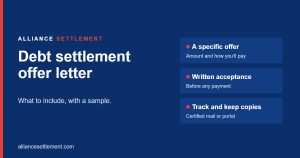
Quick answer: A debt settlement offer letter is the letter you send a creditor or collector proposing to pay less than the full balance. It should identify the account, state a specific amount and how you will pay it, ask for the agreement in writing before you pay and avoid giving the creditor access to your bank account. Keep it short, factual and polite, send it in a way you can track and don’t pay anything until you have the creditor’s written acceptance.
If you are negotiating a debt yourself, putting your offer in writing keeps the terms clear and gives you a record. This is the letter you send first. The creditor’s reply, the settlement agreement, is a separate letter, and it is the one you need before you pay.
What to include
- Your name, address and the account number (the last four digits are often enough), plus any reference number the collector uses.
- A specific offer. A dollar amount, not a range, and whether it is a lump sum or a short payment plan.
- A short reason. One or two sentences about hardship, such as job loss, medical bills or reduced income, is enough.
- What you want in return. That the creditor accepts the amount as payment in full of the account and confirms it in writing.
- How you will pay. A payment method you control, such as a cashier’s check or a one-time payment you initiate.
- A deadline to respond. Two to three weeks is common.
How much to offer
There is no fixed rule. Creditors and debt buyers look at how old the debt is, who owns it now and what you can realistically pay. Many people start lower than what they can afford and leave room to go up. Here is how much credit card companies typically settle for, and what a charged-off account means for your negotiation.
Sample debt settlement offer letter
[Your name]
[Your address]
[Date]
[Creditor or collection agency name]
[Their address]
Re: Account ending in [last four digits]
Reference number: [if any]
To whom it may concern:
I am writing about the account referenced above. Because of [brief reason, for example a job loss in March 2026], I am not able to pay the full balance of $[balance].
I am offering to pay $[amount] as a single payment to settle this account in full. [Or: I am offering to pay $[amount] in [number] monthly payments of $[payment].] I can make the payment within [number] days of receiving your written acceptance.
If you accept, please send me a letter on your letterhead confirming that the payment of $[amount] will settle the account in full, that no balance will remain and how the account will be reported to the credit bureaus. I will not make any payment until I receive that letter.
Please respond by [date]. This letter is not an acknowledgment that I owe the full amount claimed.
Sincerely,
[Your name]
How to send it
- Send it in a way you can track, such as certified mail with return receipt, or through the creditor’s written message portal.
- Keep copies of the letter and any reply.
- Check who owns the debt first. If it is with a collection agency, verify the debt collector before you send an offer.
- Be careful with old debts. In some states, a payment or a written acknowledgment can restart the clock on a debt that is past the statute of limitations. Here is how the statute of limitations works.
After you send it
- Expect a counteroffer. Creditors often reply with a higher number. You can accept, counter or wait.
- Get the agreement in writing. Before you pay, the creditor’s letter should state the amount, the payment date and that the account will be settled in full. Here is what that settlement letter should say.
- Pay exactly as agreed and keep proof of payment.
- Watch your credit report to make sure the account is updated.
Here is the full process for settling debt yourself.
How Alliance Settlement can help
Alliance Settlement helps people with unsecured debt, including credit cards, personal loans and medical bills. We review everything you owe, explain your options in plain language and negotiate with each creditor on your behalf. There are no upfront fees, and programs typically run 12 to 48 months. Results vary by case. Call (866) 376-2333 for a free consultation.
Frequently asked questions
What should a debt settlement offer letter say?
It should identify the account, state a specific amount and how you will pay it, briefly explain your hardship, ask for written confirmation that the payment settles the account in full and set a deadline to respond.
How much should I offer in a debt settlement letter?
There is no fixed amount. It depends on the age of the debt, who owns it and what you can pay. Many people start lower than what they can afford and leave room to negotiate.
Should I pay before I get a written agreement?
No. Wait for the creditor’s written acceptance stating the amount and that it settles the account in full, then pay exactly as agreed.
Can a settlement offer restart the statute of limitations?
In some states, a payment or written acknowledgment of the debt can restart the clock on an old debt. Check your state’s rules before sending an offer on a very old account.
Should I give the creditor access to my bank account?
It is safer not to. Use a payment method you control, such as a cashier’s check or a one-time payment you initiate.
This article is for general information and isn’t legal, tax or financial advice. Rules vary by state.