
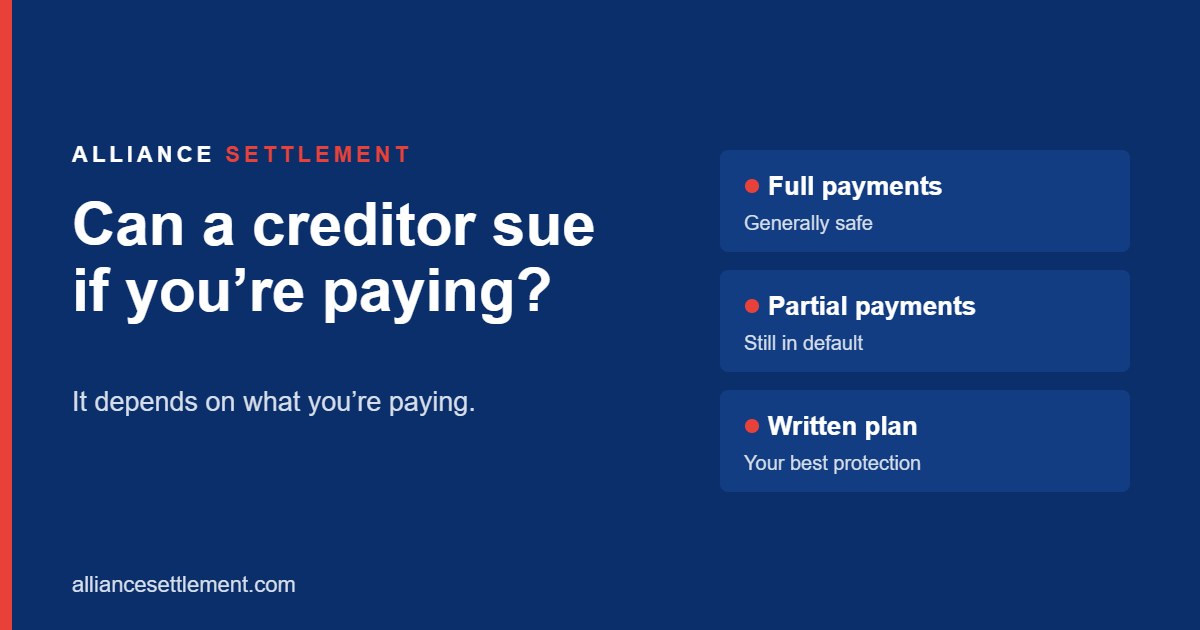
Quick answer: If you are making the full payments your contract requires, a creditor generally has no reason to sue. But if you are paying less than the required amount, or paying under an informal arrangement that isn’t in writing, the account is usually still in default and the creditor can sue. Partial payments don’t stop a lawsuit on their own. The best protection is a written payment agreement, and if you are sued, respond by the deadline.
Many people assume that sending something each month keeps a creditor from going to court. Whether it does depends on what you are paying and what you agreed to.
When you’re safe, and when you’re not
| Your situation | Can the creditor sue? |
|---|---|
| Paying at least the required minimum, on time | Generally no; the account isn’t in default |
| Paying less than the minimum, with no agreement | Yes; the account is still in default |
| On a payment plan agreed only by phone | Possibly; there may be no proof of the terms |
| On a written payment plan, paying as agreed | Usually not while you keep it, if the agreement says so |
| Saving in a debt settlement program | Yes; creditors can sue while you save |
Why partial payments don’t stop a lawsuit
Your card or loan agreement sets the payment you owe. Paying less, even every month, usually leaves the account past due, and late fees and interest keep adding up. A creditor can accept your partial payments and still decide to sue for the full balance. Here is what happens month by month when you stop paying a credit card.
How to protect yourself
- Get any payment plan in writing. It should state the monthly amount, the dates and that the creditor will not sue or send the account to collections while you keep paying.
- Keep proof of every payment. Bank records or receipts are your evidence if the creditor later says you missed one.
- Ask about hardship programs. Many card issuers offer temporary lower payments or interest rates for people who ask.
- Be careful with old debts. In some states, a payment on a debt past the statute of limitations can restart the clock. Here is how the statute of limitations works.
If you’re sued anyway
- Don’t ignore the papers. You usually have 20 to 30 days to respond, depending on your state and court. Missing the deadline can lead to a default judgment and wage garnishment.
- Bring your payment records. Proof of a written plan or regular payments can matter to the court and in negotiations.
- Ask about settling. Many lawsuits are settled before trial. Here is what to do if you’re served and whether you can settle after a judgment.
How Alliance Settlement can help
Alliance Settlement helps people with unsecured debt, including credit cards, personal loans and medical bills. We review everything you owe, explain your options in plain language and negotiate with each creditor on your behalf. There are no upfront fees, and programs typically run 12 to 48 months. Results vary by case. Call (866) 376-2333 for a free consultation.
Frequently asked questions
Can a creditor sue me if I’m making payments?
If you are paying at least the required amount on time, generally no. If you are paying less than required without a written agreement, the account is usually still in default and the creditor can sue.
Do partial payments stop a lawsuit?
Not on their own. A creditor can accept partial payments and still sue for the full balance. A written payment agreement gives you more protection.
Can a debt collector sue me while I’m on a payment plan?
If the plan is in writing and says the collector won’t sue while you keep paying, it usually won’t. Get the terms in writing and keep proof of every payment.
Can I be sued while I’m in a debt settlement program?
Yes. Creditors can sue while you are saving toward settlements. If that happens, respond by the deadline and tell your settlement company right away.
How long do I have to respond if I’m sued?
Usually 20 to 30 days, depending on your state and the court. Check the summons for the exact deadline.
This article is for general information and isn’t legal, tax or financial advice. Rules vary by state.